
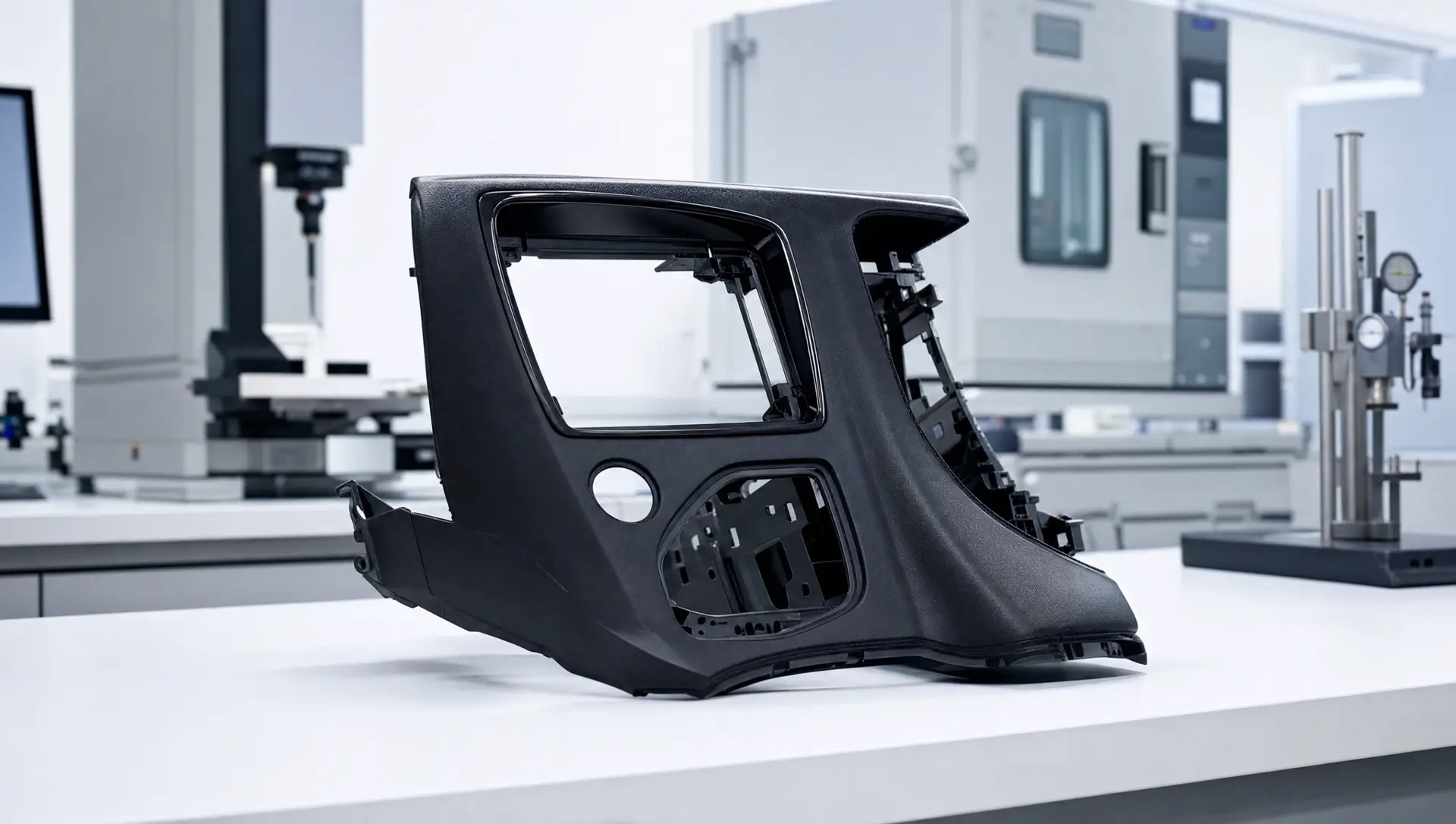
Why do SOP dates fail even though development and production are supposedly finished?
The uncomfortable answer: all too often, it is due to the initial sample inspection.
What many companies still view as a formal closing process is, in reality, one of the biggest risk factors in the entire development cycle. Delayed testing, misinterpreted results, or missing OEM approvals can cost weeks—often precisely when there is no time left.
Initial sample inspection in the automotive industry is not a box to tick at the end. It is the moment that determines whether your series start-up runs smoothly or starts to slip.
5 Uncomfortable Truths About Automotive Initial Sample Inspections
Truth 1: Certificates are not enough—without OEM approval, nothing works
Many rely on accreditations such as DIN EN ISO 17025 or IATF 16949. In practice, however, that is no longer sufficient.
OEMs are increasingly imposing their own requirements, including specific approvals and extensive on-site audits. In some cases, specific test equipment is even mandated. This is exactly where the OEM-specific test standards we use come into play.
This means that choosing a testing laboratory becomes a strategic decision. It is not the certificate that matters, but recognition within the respective OEM system.
Consequence: If you choose incorrectly here, you risk retesting, delays, and—in the worst case—the loss of valuable time in the SOP process.
Truth 2: Your schedule is probably too optimistic
Development is getting faster. Processes are becoming more agile. But physics is non-negotiable.
Climate tests, ageing tests, or long-term storage follow fixed time requirements. If a standard specifies weeks, that cannot be optimized away. A climate change test, for example, runs through defined cycles that cannot be shortened.
A typical scenario: pre-production is delayed, test slots lapse, capacities have to be rescheduled. And suddenly, the very time you previously saved is missing.
The reality: Many SOP delays are caused not by errors, but by unrealistic time assumptions.
Truth 3: Digitalization accelerates—and simultaneously increases—risks
OEM portals and digital processes have significantly accelerated initial sample inspection. Results are available immediately and visible immediately.
The problem: Deviations are also visible immediately, often without context. A minimal measured value outside the tolerance can appear directly as a fail, even though it is technically non-critical.
Without coordination, this leads to:
- misinterpretations
- unnecessary escalations
- additional loops in the process
The key insight: Digitalization does not replace expert assessment. If you do not actively put results into context, you lose control over how they are interpreted.
Truth 4: Individual parts are no longer enough—systems decide
Requirements for components have changed dramatically. Modern components are no longer isolated parts. They are part of complex systems, with electronics, sensors, and functional dependencies.
This has a direct impact on testing:
- Material tests alone are no longer sufficient
- Functions must be assessed under real-world conditions
- Assemblies are moving into focus
The challenge: More complexity means more need for coordination, higher testing requirements, and increasing time pressure. A look at the full range of our test methods shows how broad today’s requirements have become. Anyone who continues to think only in terms of individual parts will not meet the demands of modern vehicles.
Truth 5: Sustainability makes everything more demanding, not easier
New materials, bio-based plastics, sustainable alternatives: what makes ecological sense brings new technical challenges.
Because:
- Material properties change
- Long-term behaviour is often harder to predict
- Requirements for quality and surface finish remain consistently high
Especially with new materials, tests such as emissions and VOC analysis or flammability are becoming more important because material behaviour is changing.
The result: Initial sample inspection becomes more demanding, not easier. The central question is: How can sustainability and performance be ensured at the same time? The answer determines series readiness.
Conclusion: Quality is not created in the test report
Today, initial sample inspection is far more than a formal process. It is a critical decision point in the entire development cycle. This is where the following converge:
- standards and OEM requirements
- physical limits
- increasing complexity
- time pressure in SOP
The decisive difference is not whether testing is performed, but how results are understood. Quality is not created through documentation. It is created through correct interpretation, experience, and sound technical assessment.
Your partner for reliable decisions in initial sample inspection
At ASO, we support you in not only carrying out initial sample inspections in compliance with standards, but also using them as a strategic instrument:
- clear test strategies
- sound evaluation of results
- rapid classification of deviations
- coordinated overall reports from a single source
This results not in mere test reports, but in robust decision-making bases for your series start-up.
Talk to us about your current situation before small deviations turn into major delays.
Frequently Asked Questions About Automotive Initial Sample Inspection
What is an initial sample inspection in the automotive sector?
Initial sample inspection (initial sampling) assesses whether the first series-ready manufactured component meets all drawing, standard, and OEM requirements. The result is documented in the initial sample inspection report (EMPB) and is a prerequisite for series approval.
Is ISO 17025 or IATF 16949 accreditation sufficient for OEM approvals?
No. Accreditations are the foundation, but many OEMs additionally require their own approvals, on-site audits, and in some cases specified test equipment. What matters is recognition within the respective OEM system.
What is the difference between EMPB and PPAP?
The initial sample inspection report (EMPB) is the VDA-oriented documentation used in German-speaking countries; PPAP (Production Part Approval Process) is the North American counterpart under AIAG. Both demonstrate series readiness, but differ in structure and required evidence.
How long does an initial sample inspection take?
That depends on the scope of testing. Climate tests, ageing tests, and long-term storage follow fixed standard requirements and cannot be shortened. This duration must be factored into SOP planning early on.
Why do initial sample inspections often delay series start-up?
Usually not because of errors, but due to overly optimistic time assumptions, lapsed test slots, and misinterpreted deviations from OEM portals. A well-founded expert assessment prevents unnecessary escalations.