
What ¹H-NMR spectroscopy reveals – and why it is relevant for every paint shop
A paint shop is struggling with inhomogeneities in the paint finish. Suspicion quickly falls on the hardener – and rightly so? Not quite. Because the material itself was not the problem. The problem was how it was handled.
To prove this beyond doubt, ¹H-NMR spectroscopy was used. No guessing, no assumptions – just molecular evidence.
Three scenarios, one clear result
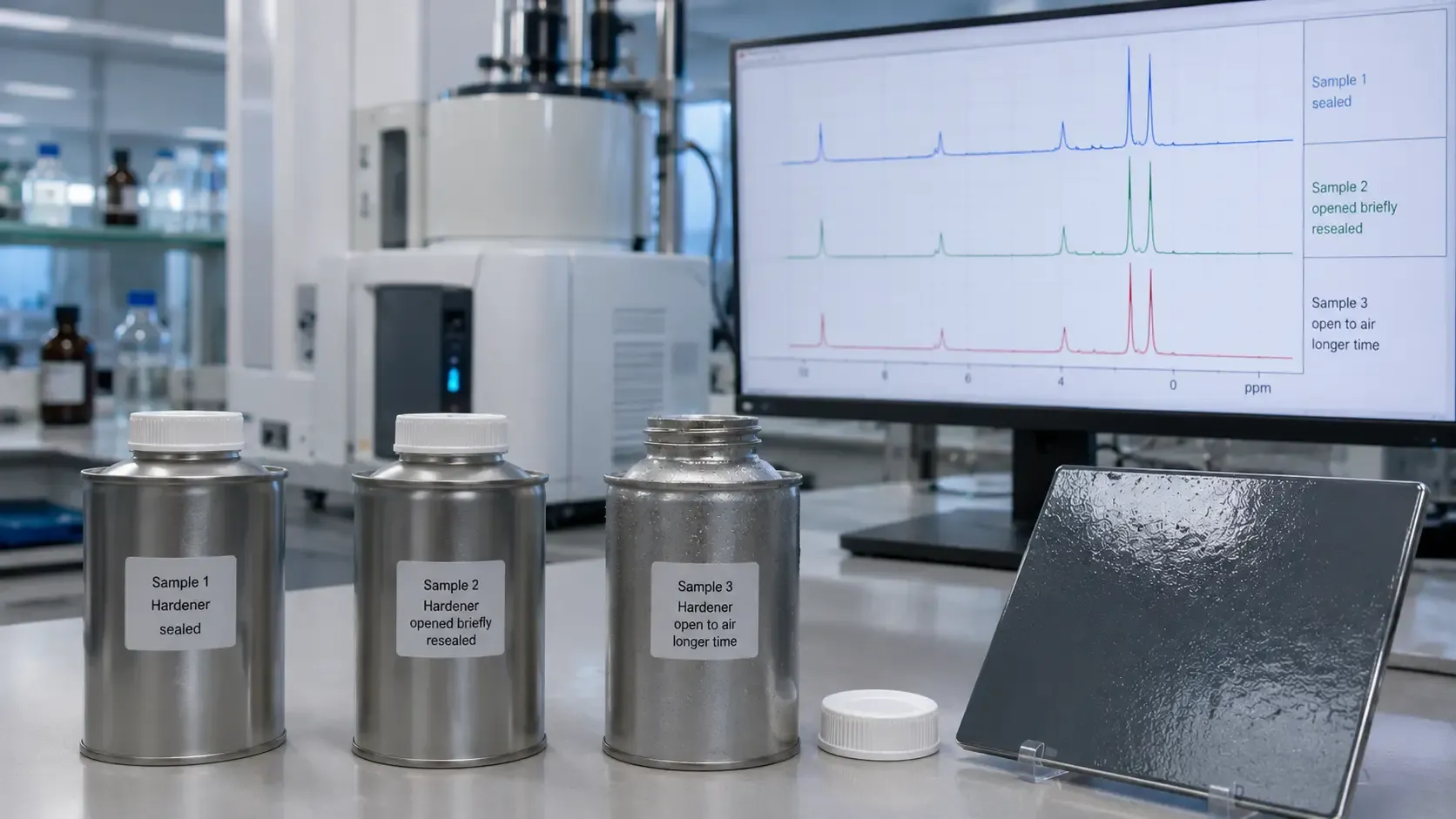
The hardener – based on isocyanates, acrylates, and solvents – was examined under three realistic storage conditions: permanently sealed, briefly opened and resealed, and exposed to air for an extended period.
The first two samples? Chemically identical. No changes, no impairment. Briefly opening the container for removal leaves no trace – as long as it is tightly resealed afterward.
But what happens if the container remains open for a longer period?
The NMR signals of the isocyanates showed clear changes: weakened peaks, shifted signals – both typical signs of a reaction with atmospheric moisture. The isocyanates had already reacted before the hardener even reached the spray gun.
Moisture strikes – quietly and invisibly
That is exactly what makes it so treacherous: you cannot tell by looking at the hardener in the container whether it is still intact. The reaction with atmospheric moisture occurs quietly, without discoloration, odor, or visible change. The problem only becomes apparent in the finished paint finish – and by then, it is too late.
The solvent content had only decreased marginally, and the acrylates remained completely stable. Only the isocyanates had reacted. This means that if a container is not stored correctly, the most reactive – and thus most important – part of the hardener is specifically destroyed.
The good news: This can be completely avoided. Not through complex measures, but through consistent sealing. Anyone who follows this will have no problems – the NMR data clearly proves this.
Analytics that provide clarity
What this case shows: if something goes wrong in a paint shop, it pays to take a closer look – at the molecular level. ¹H-NMR spectroscopy provides facts, not assumptions. And sometimes it turns out that the material was not the problem at all.
“Dr. André Muthig, our expert for NMR spectroscopy and chromatography, also provided the technical basis for an article in Storage makes the difference – better painting.”