
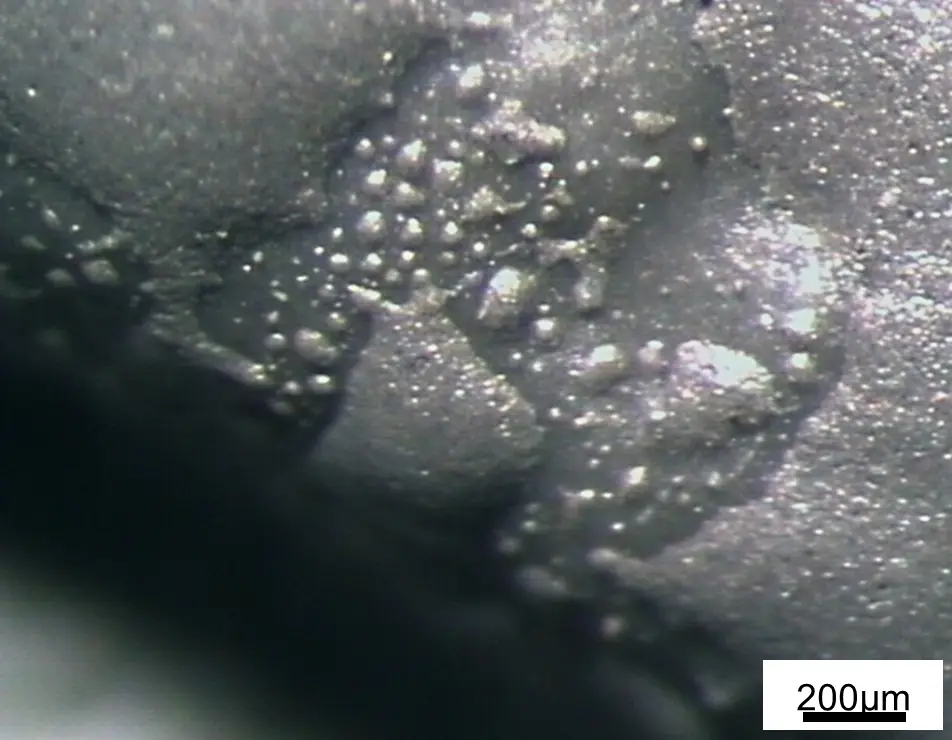
“The paint is pulling back.”
“We keep receiving complaints.”
“Everything looks clean in production – but something isn’t right.”
We regularly receive such inquiries when painted plastic components suddenly exhibit adhesion problems. The problem often only becomes visible in the finished product: the paint forms droplets, so-called wetting defects, or partially detaches again.
However, the actual cause almost always lies where it cannot be seen – in the uppermost nanometers of the surface.
The Problem Lies in the Nanometer Range
For paint to adhere, the surface must be wettable. The chemical composition of the interface between plastic and coating is decisive.
Even extremely thin contamination layers – for example from silicone oils, release agents, or migrating additives – can alter the surface energy in such a way that the paint does not form a stable bond.
The difficulty: We are talking about layers in the range of 5–10 nanometers. This corresponds to approximately one-thousandth of the thickness of a human hair.
A Concrete Case from Practice
A typical paint defect appeared at a client’s facility:
- In the affected area, the paint formed small droplets – a clear sign of inadequate wetting.
- Mechanical tests provided no clear indication. Visually, the surface appeared unremarkable.
- Only analysis using ESCA (Electron Spectroscopy for Chemical Analysis) provided clarity.
What the ESCA Analysis Revealed
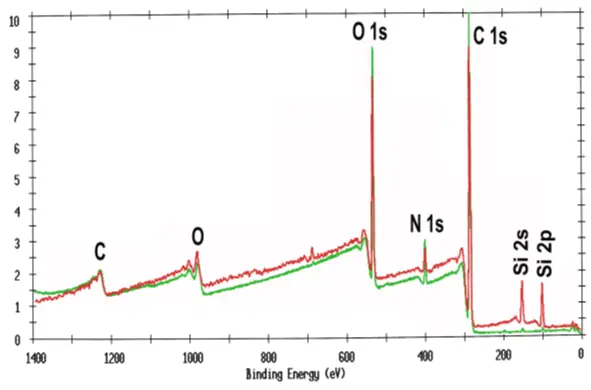
In the defect area, a significantly elevated silicon concentration of 8–14 at% was measured.
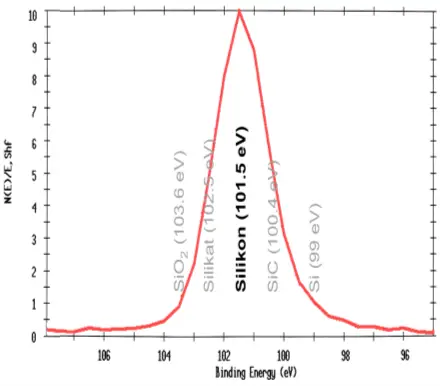
Detailed spectral analysis clearly showed: the silicon originated from a silicone oil.
After cleaning with acetone, the silicon signal disappeared completely – and with it the wetting defect.
The cause was thus clearly identified: An extremely thin silicone contamination had prevented adhesion.
Why Such Cases Are Typical
Silicone compounds are ubiquitous in industrial environments – in lubricants, release agents, seals, or through environmental transfer.
Even the smallest amounts are sufficient to massively impair adhesion.
Without a surface-sensitive method such as ESCA, the cause often remains hidden – and complaints recur.
Conclusion
Adhesion problems with painted plastic components often do not arise from the paint itself, but from invisible changes to the surface.
Targeted surface analysis in the nanometer range makes it possible to clearly detect contamination and sustainably improve processes.
And that is precisely where genuine root cause analysis begins.
Do you have a similar problem? Our team supports you with failure analysis and identification of surface contamination. Contact us for individual consultation.